Natural Selection Never Stopped
We just built a world where it rarely gets a vote

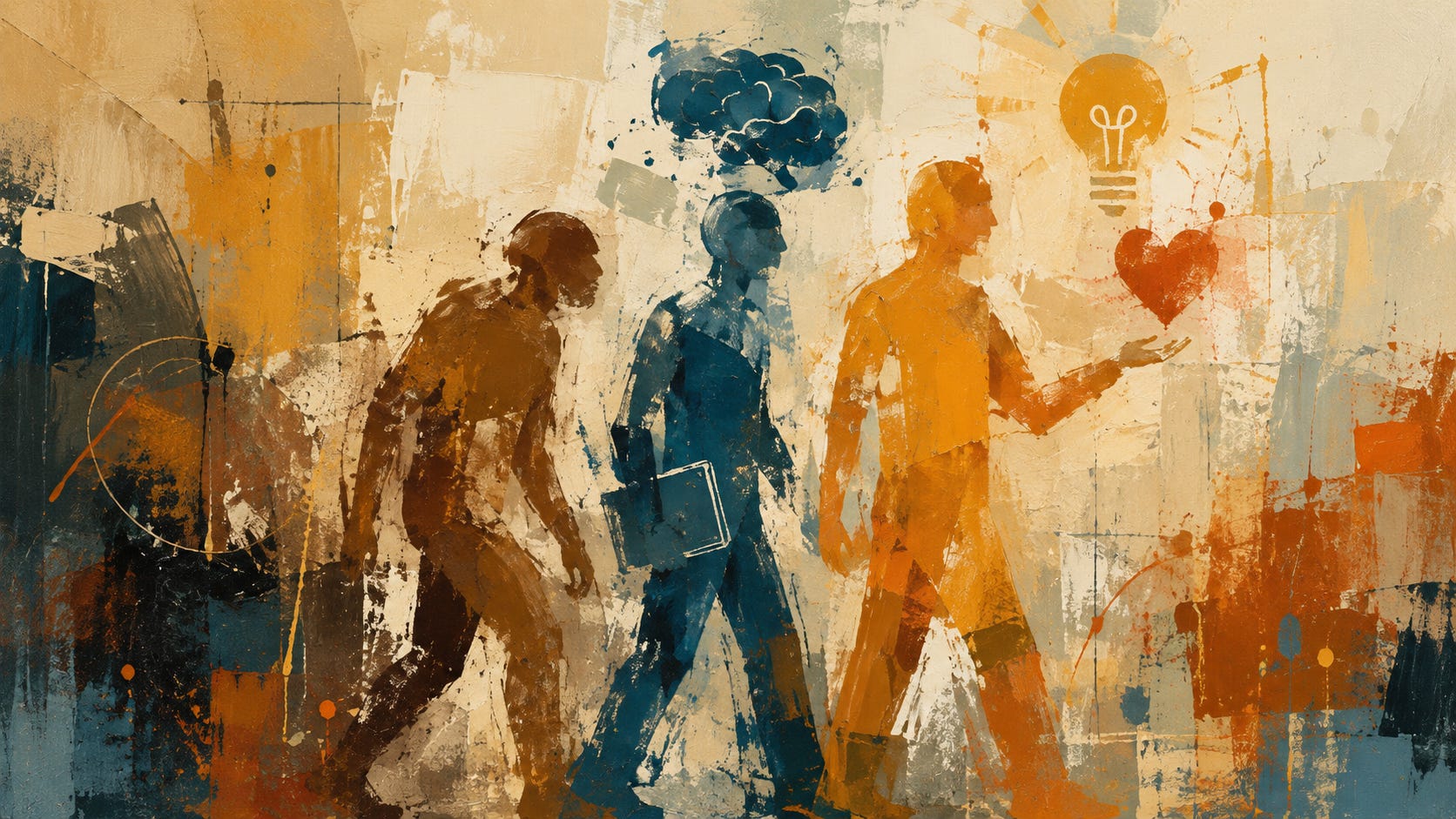
For hundreds of thousands of years, your body was your insurance policy.
If danger came, you ran.
If food was scarce, you searched.
If the weather turned, you adapted.
Your heart, your lungs, your muscles, your instincts. They weren't hobbies. They were the difference between seeing another sunrise or not.
Then civilisation happened.
We built houses that kept out the weather. Supermarkets that kept away hunger. Hospitals that fought disease. Police that reduced violence. The internet meant knowledge no longer had to be earned, only searched for.
We insulated ourselves from the world that shaped us.
And over time, we insulated ourselves from something else.
Consequences.
Today, many of us couldn't sprint for thirty seconds.
We couldn't climb a fence.
We couldn't carry another person to safety.
We couldn't walk twenty miles if we had to.
We struggle to lift our own body weight.
And that's before we even mention the millions who are so overweight that fight or flight has become little more than a phrase in a biology textbook.
That's not a criticism.
It's an observation.
Never before has a species been able to ignore the physical demands that created it.
Obesity isn't the point I'm making.
It's the most obvious symptom.
The symptom of a civilisation that has become so comfortable that survival no longer demands survival skills.
Think about it.
If a predator burst through your front door tomorrow, your body wouldn't ask for Wi-Fi.
It wouldn't ask what your job title is.
It wouldn't care how many followers you have.
It has only ever known one language.
Fight.
Or flight.
Could you do either?
Really?
Not in the version of yourself you imagine.
The body you have today.
Could it carry your child for miles?
Could it climb?
Could it swim?
Could it survive three days without a supermarket?
Could it function if the electricity never came back on?
Now imagine the world changes tomorrow.
Not gradually.
Overnight.
The grid fails.
Supply chains collapse.
Fuel runs out.
No supermarkets.
No internet.
No emergency services.
No one coming to restore order.
How many of us would actually survive?
We've become specialists in a world that rewards specialisation. You can build an entire career behind a screen and never once need to light a fire, grow food, purify water, build shelter or navigate without GPS.
Those aren't useless skills today.
They become everything tomorrow.
We've spent generations engineering inconvenience out of life.
Escalators instead of stairs.
Cars instead of walking.
Food delivered instead of hunted.
Information searched instead of remembered.
Entertainment streamed instead of silence endured.
Every one of those things has made life better.
But together they've asked less and less of the one thing evolution spent millions of years perfecting.
Us.
We've engineered a world where our brains are exercised every day, but our bodies are excused.
The irony is that many of the traits our society celebrates wouldn't necessarily matter anymore.
Your follower count.
Your degree.
Your job title.
Your online reputation.
Nature has never cared about any of those things.
It asks much simpler questions.
Can you adapt?
Can you learn?
Can you cooperate?
Can you endure?
Perhaps the people who thrive wouldn't be the ones we expect.
The quiet gardener who knows how to grow food.
The mechanic who can keep machines alive.
The nurse.
The carpenter.
The person who can stay calm while everyone else panics.
Maybe resilience has become rarer than intelligence.
Maybe comfort has become our greatest evolutionary disadvantage.
This isn't an argument against civilisation.
Quite the opposite.
Civilisation is one of humanity's greatest achievements because it allows millions of people to survive who otherwise wouldn't.
But it leaves me with one uncomfortable thought.
Have we mistaken surviving for being capable of survival?
Because they're not the same thing.
Perhaps the next stage of human evolution won't be decided by who can code the fastest or create the best content.
Perhaps it'll still be decided by the oldest rule of all.
Not the strongest.
Not the smartest.
The ones who can adapt when the world changes.
You really have a knack for taking an everyday observation and tracing it back to evolutionary first principles.
It's the kind of writing that changes how you look at ordinary life.
Loved it!
Great piece, Jaime. I have a feeling we'll find out rather sooner than later if we're "capable of survival." And there's one thing that's been bugging me for as long as I can remember: the people who talk about the "survival of the fittest" often think they're the "fittest." The thoughts you elaborate on here never really occur to them. In the end though, they're not exempt from consequences. And when push finally comes to shove, "natural selection" will be the last thing to worry about.